You might not know a single Modern Lovers song. You might not know who Jonathan Richman it. It’s perfectly understandable. History has a maddening tendency to distill things down to the popular and overlook the significant. Richman and the Modern Lovers could have been popular, though. They secured a recording contract with Warner Bros in 1973 based on the strength of a few shit shows in school gyms and rec. centers. Clive Davis, head of Columbia Records, attended one such show. He strained his ears to hear the lyrics amongst the bored high schoolers. The Modern Lovers must’ve been the sound of the future, because those thoroughly uncool concerts earned them studio time with John Cale, who co-founded The Velvet Underground with Lou Reed and produced The Stooges’ first record. It reads like a classic rock journey to superstardom. If their record with John Cale came to be, they may be recognized today as the acclaimed founders of punk and new wave. Wittingly or unwittingly, they were that far ahead of the curve.
But the record stalled until 1976, too late for them to stake their claim. Tensions arose during the 1973 sessions. Richman wanted to get as far away from the loudness and violence of The Modern Lovers’ early songs as possible, much to the dismay of his bandmates and his producer. Eventually the conflict became insurmountable. Warner Bros. dropped the young band before a single was released. Richman’s revelations about moving toward a more acoustic, joyous sound would inform his entire solo career. His catalogue now ranges from the retrospectively influential “proto-punk” of the early Modern Lovers to the organic acoustic sound of his 1992 record I, Jonathan. Throughout the 80s, 90s, and 2000s, Richman released album after album. As prolific as he is with records, his touring schedule matches it.
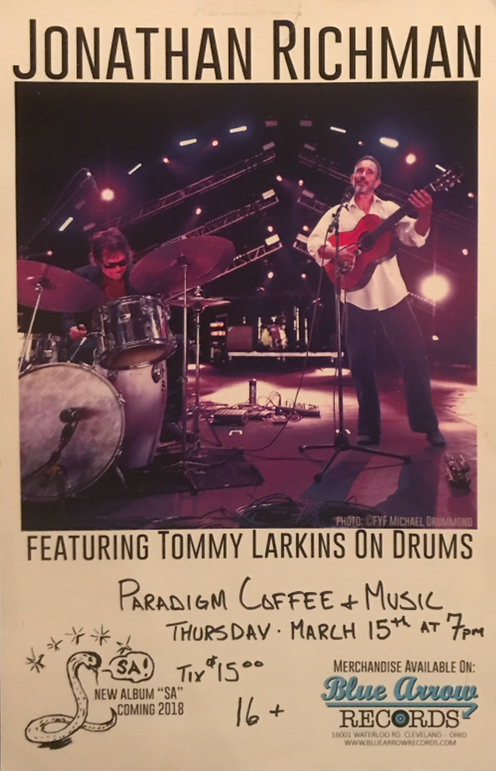
Jonathan Richman performs with a zest for life and a level of comfort that suggests he was born to do it. He does it on TV, he does it on record, and on March 15th, 2018, I got to see him do it in person. It was an honor and a privilege. Not because the show was exclusive, not because Richman is a superstar, but because he may be the last of a dying breed. The rock and roll troubadour, criss-crossing the country doing the one job they can stomach. At age 66, he’s still going; playing small venues in small cities. I drove an hour and a half to Sheboygan, Wisconsin for my chance to witness history, and it was worth every mile.
The Paradigm coffeehouse and concert hall is a trendy spot. High ceilings and the sheer size of the place make it feel like a converted warehouse, but the storefront windows that line both outer walls give it some urban chic. Bikes hang from the ceiling and Wisconsin-made craft beers are served by the bottle, along with pinot noir and freshly brewed coffee. I picked up two porters (both for me) before taking my seat at the end of the long bar closest to the stage; the perfect balance of comfort and proximity to the action. From my vantage point, I could see Richman rehearsing in the open loft above the stage. Even in private, he was plucking away at his nylon-stringed guitar with passion. Swaying back and forth, eyes closed, looking like a priest– devoted to the cause, regardless of the audience.
By the time Richman took the stage, the crowd had swelled to fill the venue, with probably 150 people in attendance. The set was heavy on tracks from his more recent albums, which might’ve frustrated the old punks in leather jackets. In fact, the only Modern Lovers song he played was a mixed up version of “Old World.” No “Roadrunner,” no “Astral Plane,” and no “Pablo Picasso.” We did get a lengthy ode to 17th century Dutch painter Johannes Vermeer, though. We also got a monologue about how the divine can exist in the presence of the ego (a reference to “Lift the Veil,” a poem by 15th century Indian mystic, Kabir), and songs in English, French, Spanish, and Italian. He danced with maracas. He rambled incoherently for minutes on end. He moved me with a heart-wrenching performance of “When We Refuse to Suffer.” From sentimental to comedic and back again, the set was amorphous. Songs bled into speeches, which bled back into songs. Spanish guitar is his current axe of choice, and though his aging fingers sometimes lose the tempo, he still coxes euphoric beauty out of his instrument. Though rough around the edges, Richman stirred the emotional pot like few performers I’ve seen.
Onstage, Richman was a soft, inviting presence. After finishing his first song, he asked everyone standing in the venue to move in close to the stage. He told them it won’t be very loud, so they had nothing to worry about. A couple songs later, he asked the people sitting in the back if they could hear him. They replied with a resounding “yes.” The current of inclusivity ran through the whole crowd. During his performance of “When We Refuse to Suffer,” he compared those with guarded hearts to “stovetop pizza” and “screwtop wine;” nothing more than an unfeeling commodity. We laughed. Seconds later he proclaimed: “If we refuse to suffer, if we won’t feel / We won’t feel the false, we won’t feel the real,” and I felt that line in my gut. Sung over cascading plucked guitar chords, it was a moment of untainted beauty still gives me chills a week later.
There was one other moment of pure beauty that night. During his encore, as the song was wrapping up, he put his guitar down. He walked past the microphone toward the crowd and gestured for us to sing the last line with him. We all sang that we needed “not so much to be loved, but to love,” and that last syllable rang out in perfectly imperfect harmony. At Richman’s urging, we came together to create that moment. I left the show wanting to love, wanting to be soft in a world that so often feels cold. During one of his last monologues, he told us that a “changing of the guard” is happening and the old world is “kicking and screaming” as it fades away. If that’s true, Jonathan Richman’s set at Paradigm helped prepare me for it. It was proof that a couple moments of collective love can reverberate forever.
Sources: Vice Piece on Ernie Brooks (founding member of Modern Lovers), Boston Globe Interview With Jonathan Richman, John Cale Interview, Jonathan Richman Wikipedia.
 The Healthy Alternative
Leave a comment